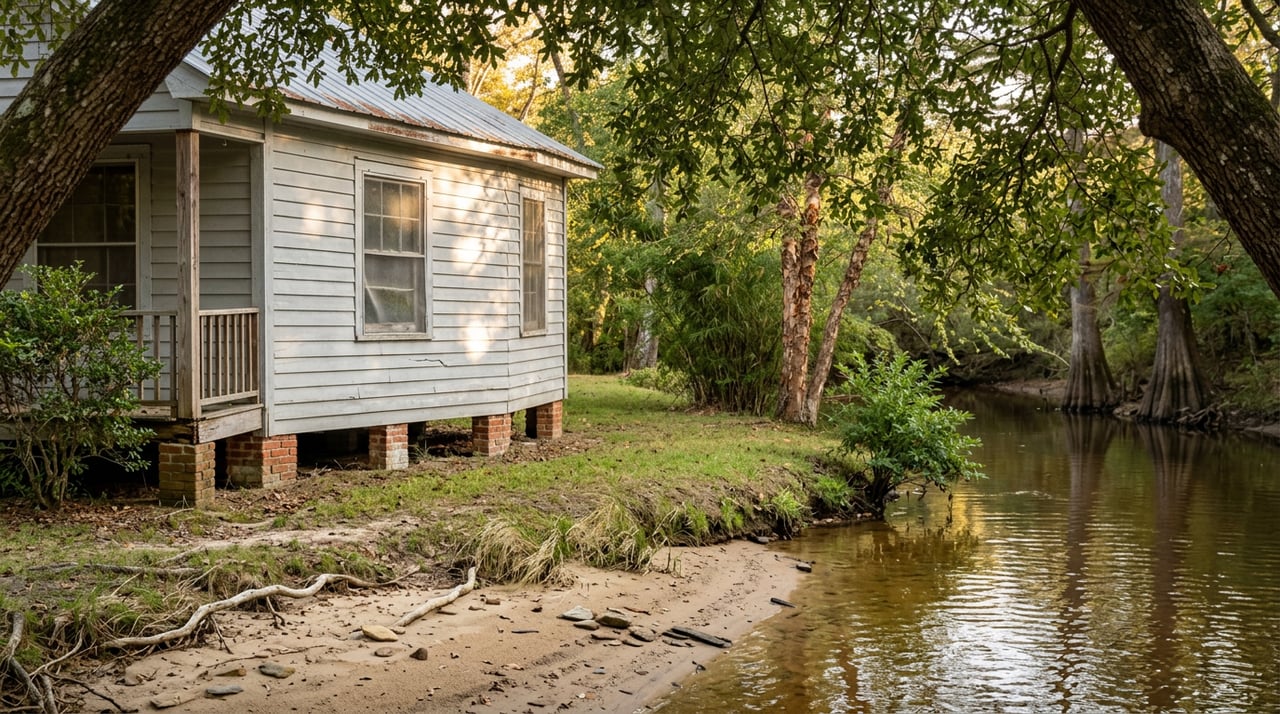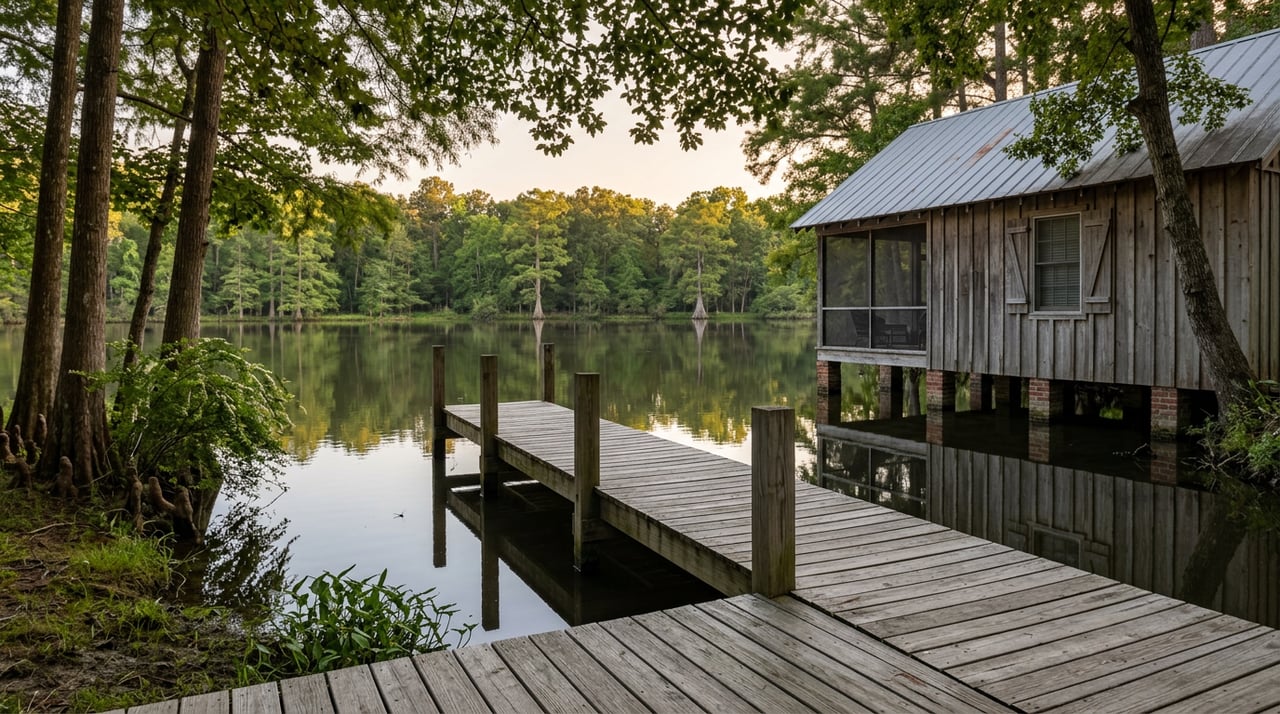
On a Friday evening in August, you can walk the Vidalia riverfront and watch a string of barges push past the bluffs of Natchez, lit orange by a sun that hasn't dropped yet. Twenty minutes later, you can be sitting on a dock at Lake Concordia outside Ferriday, and you won't see a single barge, or much of anything moving at all, just cypress shadows stretching over water that hasn't connected to the Mississippi in longer than anyone alive remembers.
Same parish. Same river system, technically. Two completely different places. Most people who live here treat that difference as just weather or mood, a livelier spot versus a quieter one. It's actually geology and civic history, and once you know the mechanism, both places make a lot more sense.
The Riverwalk Is Standing on Old Vidalia
The paved path that runs along the levee in downtown Vidalia isn't just scenery. It's built on the literal footprint of the town's original Main Street. After the catastrophic Mississippi River flood of 1927, the Army Corps of Engineers rebuilt the region's levee system, and Vidalia's answer was drastic: the entire town picked up and moved about a mile west in 1938 to get behind the new levee line. The riverfront street grid that used to anchor the old downtown was left behind, and what sits there now, the boardwalk you walk after work, was built on that abandoned ground. The first bridge connecting Vidalia to Natchez went up two years later, in 1940.
That's why the flood numbers here read so differently than they do downriver. Flood stage in this stretch of the Mississippi is 48 feet, compared to 27 feet at Donaldsonville and 17 feet at New Orleans. The river doesn't behave the same way in every parish it touches, and Vidalia's whole layout, right down to where Front Street sits today (112 Front Street marks the current riverwalk trailhead), is a direct response to that fact.
The infrastructure built around the walk since then leans into the same relationship with the river rather than away from it. The Vidalia Conference and Convention Center sits directly on the riverfront, across from historic Natchez, with 20,000 square feet split across seven rentable rooms, and it's positioned right next to the Riverfront RV park and an amphitheater that hosts outdoor events on the water. It's a working piece of civic infrastructure, not a museum piece, which fits a town whose whole downtown was once picked up and rebuilt on purpose.
Walk it at sunset, then head a few blocks up Carter Street for dinner, and you're covering the same ground the town has occupied twice: once as agricultural riverfront, and now as a relocated grid built to survive the next flood. Johnnie Mae's Seafood & Grill and Sportsman Fish & Grill both serve the kind of catfish plate that makes sense after a walk like that, and Sonny's Pizza and Nikki's Restaurant round out the corridor if seafood isn't what you're after that night.
Lake Concordia Never Moved. The River Did.
Lake Concordia didn't get relocated. It got abandoned, in a much older and slower sense. It's an oxbow lake, a stretch of roughly 1,000 acres near Ferriday that used to be part of the Mississippi's main channel before the river changed course and cut it off. Where Vidalia's downtown moved away from the river on purpose in 1938, Lake Concordia is what happens when the river moves away from itself, over centuries instead of a construction season.
That history shows up in the water. The lake averages 10 to 15 feet deep across most of its surface, but a handful of old channel holes drop to more than 55 feet, a leftover of the river's original bed. Ancient cypress trees line much of the shore. The Louisiana Department of Wildlife and Fisheries has placed two manmade reefs at either end of what locals call the "blue hole," and that structure holds bass and crappie at different points in the year, which is exactly why the lake has produced largemouth bass exceeding 13 pounds. After dark, anglers work the lit docks along the shoreline, where the lights pull in baitfish and give largemouth an easy meal once the daytime heat backs off.
Because it's an oxbow rather than open river frontage, roughly half the shoreline is privately owned, which is part of why a Saturday night here feels so different from a Friday on the Vidalia boardwalk. There's a free public ramp on the lake's north end, and two commercial lodges, including Lakeview Lodge, on the south end for anyone who wants a weekend without towing a boat home. Ferriday itself, fifteen minutes from Natchez, is the town's own quiet landmark: it's where Jerry Lee Lewis was born and raised, a fact that shows up more in conversation than on any sign.
Why That Split Actually Matters for How You Spend a Weekend
Once you see the mechanism, the two spots stop competing for the same kind of night out. The riverwalk is public, lit, built for foot traffic and barge-watching, and it sits on ground the town deliberately repurposed after a disaster. Lake Concordia is private-feeling, quiet, structured by fish behavior instead of foot traffic, and it exists because the river simply left it there. One is civic infrastructure. The other is geology that happened to end up good for bream and bass.
A weekend that actually uses both looks something like this:
- Friday evening: Walk the riverwalk from Front Street while the barges move, then grab catfish or gumbo on Carter Street at Johnnie Mae's or Sportsman Fish & Grill.
- Saturday afternoon into evening: Head out to Lake Concordia, launch from the free LDWF ramp on the north end or base out of Lakeview Lodge on the south end, and fish the blue hole reefs as the light drops and the dock lights take over.
- Sunday: If it's late August, circle the calendar. Delta Charter is hosting a football jamboree on August 28, with Vidalia and Delhi both on the field, a small but genuine marker of the season turning.
The parish isn't standing still around either of these spots, either. Vidalia just raised its water rates for the first time since 2011, and the town council has been walking through a wish list of projects funded by surplus revenue from the Sidney A. Murray Jr. Hydroelectric Station. The Concordia Parish Police Jury has been reviewing proposed facade designs for the courthouse. None of it is dramatic, but it's the same instinct that moved the entire town in 1938: when the infrastructure needs adjusting, Concordia Parish adjusts it rather than waiting it out.
That's the part worth knowing if you live here and just thought of the riverwalk and the lake as two nice places nearby. They're not variations on the same theme. One is the town's answer to a river it couldn't control. The other is what that same river left behind when it moved on to somewhere else. Knowing which is which changes how you plan the weekend, and it's a good reminder that even a place this familiar still has a story most people haven't heard yet.
If you're weighing what it would take to actually live along either stretch of water, from a place near the riverwalk to something closer to Lake Concordia's quieter shoreline, the team at Stedman Ulmer Properties knows this parish block by block and can walk you through what's realistic on either side of that levee.